AI Governance in the Philippines: Owning AI Isn't Enough
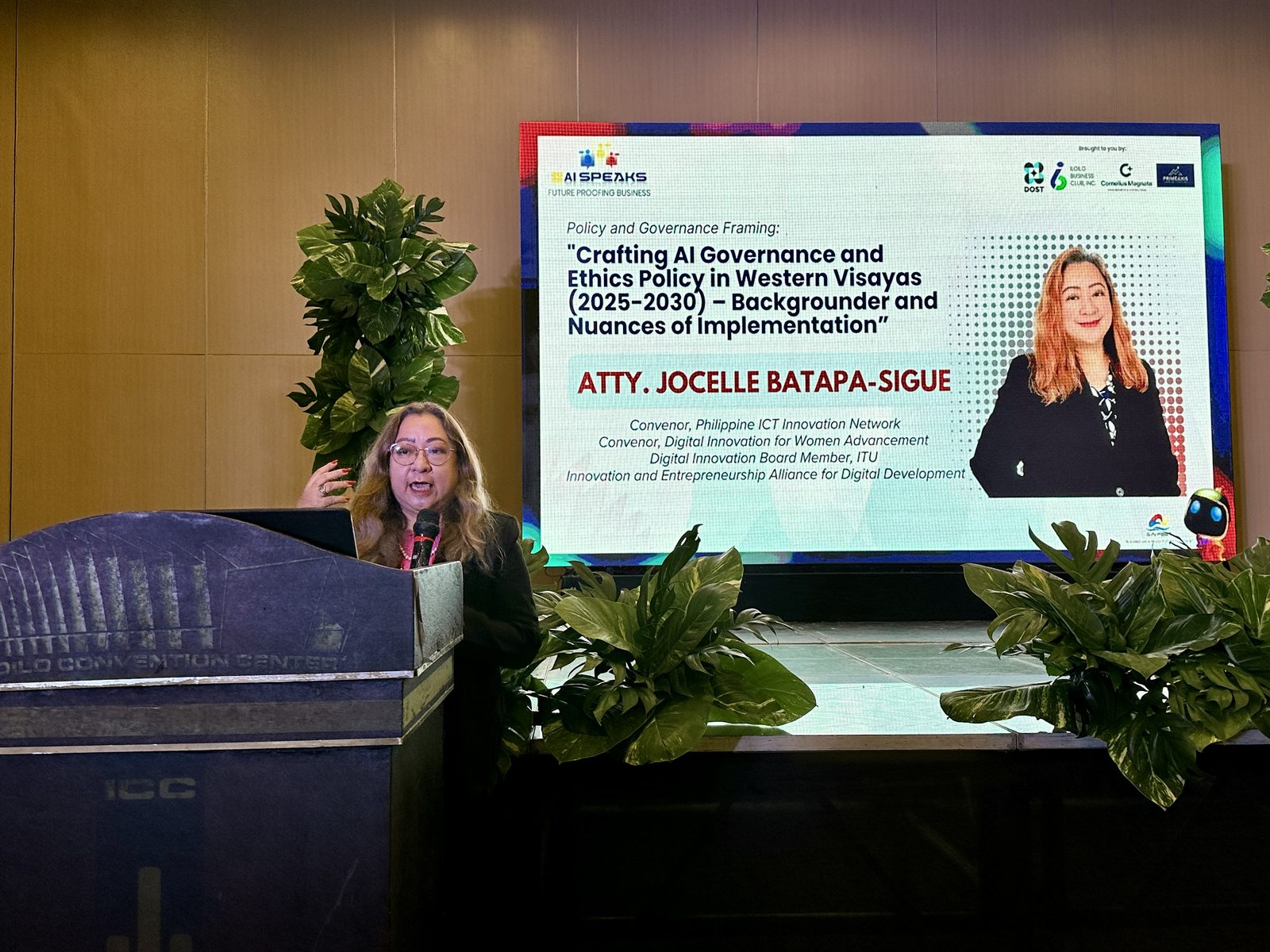
AI governance in the Philippines reached a milestone in 2026: Western Visayas approved the country’s first fully developed regional AI governance and ethics policy. Framed by lawyer and former DICT Undersecretary Jocelle Batapa-Sigue, it marks a shift from whether businesses use AI to whether they can answer for it.
I was one of the speakers at AI Speaks, part of AI Fest 2026 in Iloilo, and it was one line from another talk that stayed with me for the rest of the day. Atty. Jocelle Batapa-Sigue described the mistake she keeps seeing institutions make with AI as putting the cart before the horse, or the horse before the cart. She was pointing at the gap between adopting AI and governing it, and she is someone worth slowing down to hear on this. Batapa-Sigue is a lawyer, a former Undersecretary for ICT Industry Development at the DICT, and a three-term city councilor in Bacolod.
She is not an AI skeptic. She mentioned, almost in passing, that she has spent two years training a personal AI she calls “Jocelle AI.” Her point was not that we are using AI too much. It was that we are governing it too little.
Governance Is Not the Same as Adoption
Most business owners I talk to still measure their AI progress by what they have installed. You have probably felt that pull yourself, di ba? The dashboard is live. The chatbot answers. The team has ChatGPT now. It feels like arriving.
Batapa-Sigue’s argument is that arriving is not the milestone people think it is. Adoption and governance are two different disciplines, and they get dangerously mixed up. Adoption is buying and deploying the capability. Governance is being able to steer it, audit it, and answer for it. One is about having AI. The other is about being able to account for how you use it.
Adoption buys you capability. Governance decides whether that capability is lawful. Whether it is fair. Whether you can explain it. Whether anyone can be held to account when it goes wrong.
She anchored the stakes in the World Economic Forum’s four scenarios for the future of work. Without both governance and skilling, she warned, a country drifts toward the bad outcomes, a displacement of talent and a stalled economy. With both, you get the better ones, a co-pilot economy or supercharged growth. The technology alone does not decide which future you land in. What you build around it does.
AI Governance in the Philippines: What the First Regional Policy Actually Is
Here is why the room paid attention. The Western Visayas AI Governance and Ethics Policy 2025-2030 is the first fully developed regional AI-governance framework in the country. The Philippines already has national foundations for AI policy. What it has lacked is the means to actually implement that policy across every region, because the country is large and uneven. Region 6 is the first to close that regional-implementation gap with an approved framework of its own. It was turned over to the Department of Science and Technology in March 2026, at the Regional Development Council’s first-quarter meeting.
Batapa-Sigue pointed to the Center for AI and Digital Policy, which has tracked the Philippines as having the foundations of AI governance in place but not yet the reach to put them into practice everywhere. A regional framework is how you start closing that distance.
And then, speaking as a lawyer, she was careful about what the policy is not. It does not replace national legislation. It does not substitute for regulatory authority. It does not override sector-specific standards. Because the country still has no single horizontal AI law, the regional framework exists to guide domain-specific rules and to be implemented in harmony with existing law.
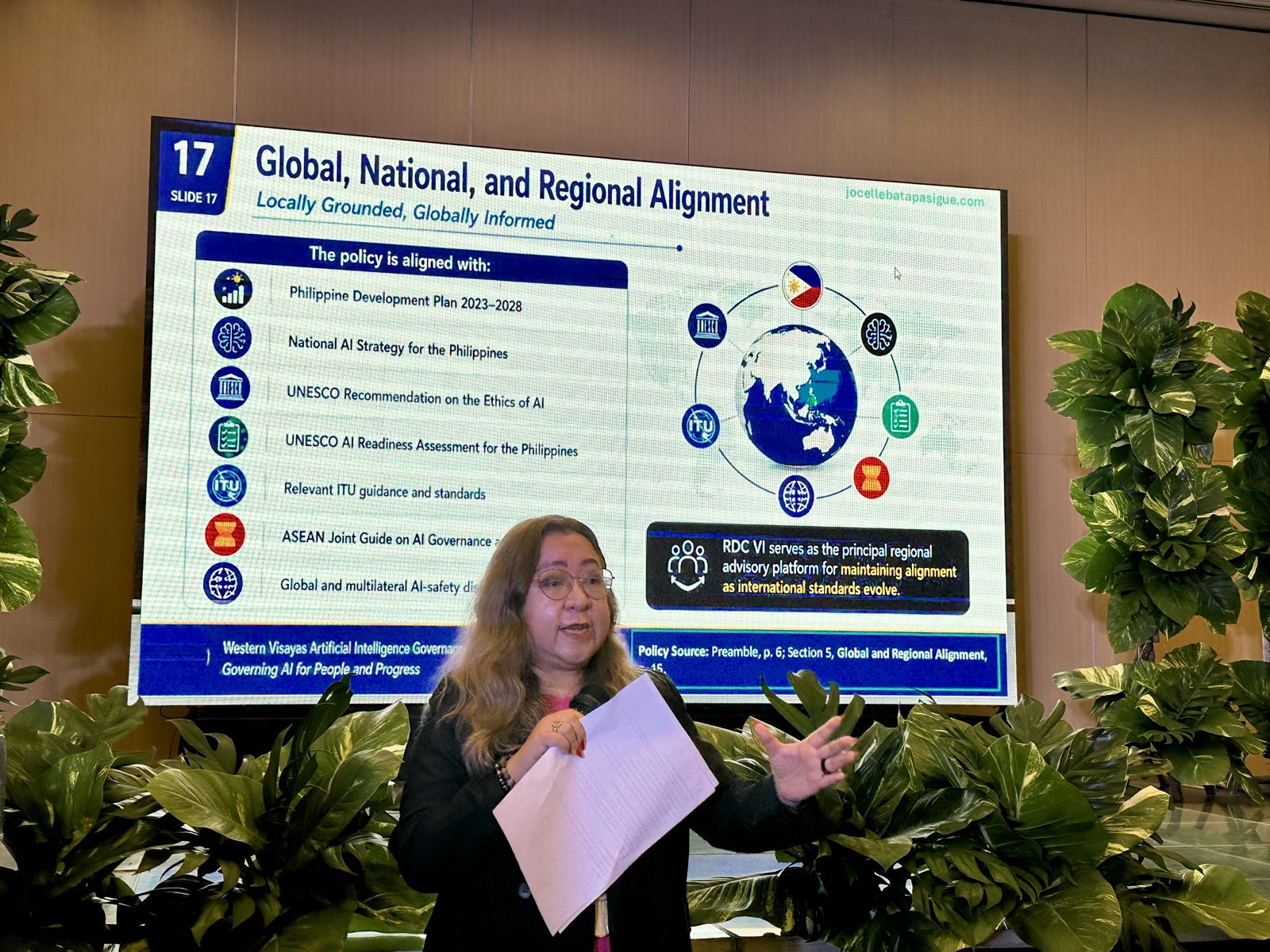
The regional policy is mapped against national plans and international frameworks, with RDC VI as the standing regional advisory platform.
That restraint is the part I would underline for any business owner. A credible governance document knows the limits of its own authority. It enables, it does not over-claim. The framework is also young, only a couple of months old at the time of the talk, with plenty of stakeholder education still ahead. Its provisions describe what the document commits to, not audited results in the field. That honesty is a feature, not a weakness.
Oversight Should Scale With Autonomy
One idea from the policy travels straight into how a business should think about its own tools. The framework separates AI into three broad classes: narrow, generative, and agentic. And it makes the implication explicit. As a system’s autonomy, scale, and decision-making rise, the oversight and risk controls around it must rise too. The policy pairs this with plain risk tiers, sorting applications into low, moderate, and high risk, with the requirements scaling to match.
This is exactly the axis I work on when I help a business decide how much governance a tool deserves. A spell-checker and an autonomous agent do not belong under the same rules. The more a system decides on its own, the more oversight it earns. That is not bureaucracy. It is proportion. An AI that only answers questions needs a lighter touch than an AI that takes actions on your behalf, and treating them the same is how good governance gets a bad name.
Read the other way, oversight is not a punishment for the powerful tools. It is the thing that lets you use them at all.
The Lines Every Business Owner Should Steal
A few of Batapa-Sigue’s sentences are worth writing on a wall. The sharpest one was about accountability.
“External procurement does not extinguish public accountability.”
She said it about government buying AI, but it lands just as hard on a private business. Outsourcing the build of an AI system, even to a vendor like the one my own company runs, does not outsource the responsibility for what it does. If the tool you bought makes a bad call, “the vendor’s model did it” is not an answer your customer will accept. You bought it. You deployed it. You answer for it.
Her second line was about fairness, and it doubles as a test you can hand a team. A system can be technically efficient and still be socially unfair. So before you ship, ask who benefits, who is left out, and who is absent from the data you trained on. Then ask whether the person on the receiving end of an AI decision can actually challenge it. Efficiency is not the same as fairness, and the gap between them is where the trouble lives.
The third idea reframes governance as something continuous, not a one-time clearance. Risk is not born only at launch. Bias enters through the data. Security flaws enter during development. New harms show up once the system is live and touching real people. So a single approval gate is not governance. Governance runs the whole life of the system, from design through monitoring and retraining, all the way to knowing how you would shut it down. For a small business the difference is simple. It is the difference between saying “we launched an AI tool” and saying “we run one responsibly, and we know how we would turn it off.”
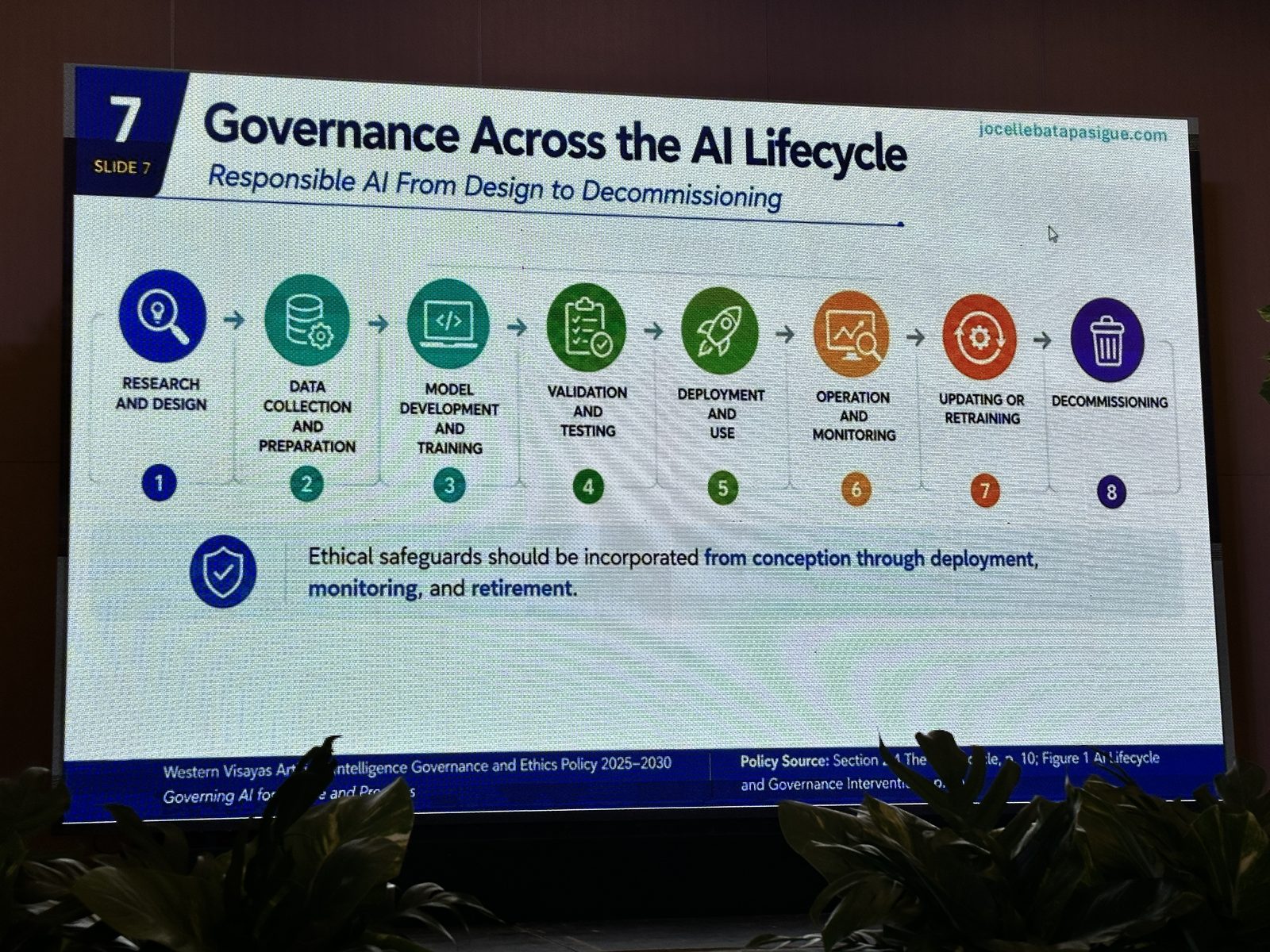
Her slide put governance across the whole AI lifecycle, from research and design to decommissioning, not at a single launch gate.
The EUREKA Test You Can Use on Monday
Batapa-Sigue shared a personal rule she runs every time she uses AI. It is not part of the formal policy. It is her own checklist, and it compresses the whole framework into six questions a business owner can actually remember. She calls it EUREKA.
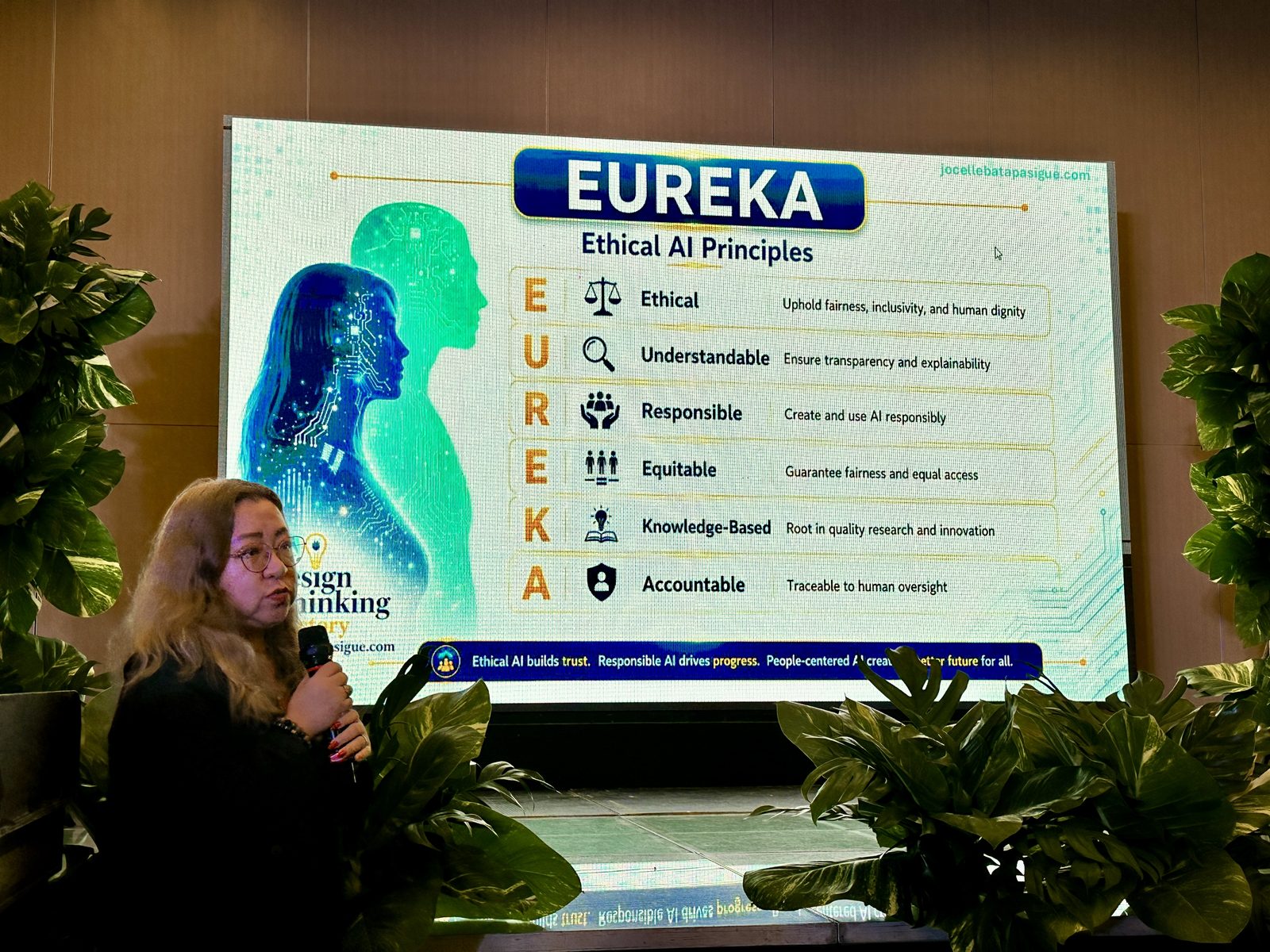
Her EUREKA checklist compresses the framework into six questions: Ethical, Understandable, Responsible, Equitable, Knowledge-Based, Accountable.
Ask whether the use is Ethical, in a way you would be comfortable defending if it were made public.
Require that it is Understandable, meaning you can explain how the tool reached its output instead of shrugging at a black box.
Assign who is Responsible, a named owner, before the system goes live.
Check that it is Equitable, by naming who is missing from your data before you ship.
Keep it Knowledge-based, by verifying the sources behind an answer rather than trusting the confident tone.
And settle who is Accountable, deciding in advance who answers when it goes wrong.
Six plain questions, no jargon, and every one of them is something you can do this week. Here is where to start. Pick one AI use already running in your business, the one closest to a real decision, and run it through the six questions honestly. Where you cannot answer one, you have just found your next piece of work. Write down who is accountable for that use, on paper, with a name on it. That single step does more for your governance than any new tool, and it is the natural companion to The 4A Blueprint.
Governance Is Becoming the Price of Being Taken Seriously
There was a quieter point underneath the whole session, and it was about money. A region that has its AI policy in place can tell investors it is ready. The host made the same point at the close: capital does not want to enter a place where the rules are undefined. Western Visayas is now positioning its governance work as an investment signal, precisely because the hard questions already have answers.
That logic does not stop at regional borders. A private business no policy yet compels is heading toward the same test. Your customers, your partners, and eventually your buyers will want to know not just that you use AI, but that you can account for how you use it. Governance is quietly becoming the price of being taken seriously.
So before your next AI project, it may be worth asking a different question.
Can we say we use AI?
Or can we answer for how we use it?
Almost everyone can now say yes to the first one. The second is the one that will separate the businesses people trust from the ones they don’t.

Jerry Ilao
AI Business Strategist · Creator of The 4A Blueprint
Jerry Ilao is the founding president of the Philippine AI Business Association (PAIBA), co-founder and CEO of AI consulting company Olern, and co-founder of Tarkie, field-work software used by 15,000+ Filipinos. He has led 200+ digital transformation projects since 2014 and now helps Philippine businesses adopt AI through The 4A Blueprint™, his practical framework for progressing from AI assistants to automation, agents, and AI-first operations.
Sources
- Atty. Jocelle Batapa-Sigue, "Crafting AI Governance and Ethics Policy in Western Visayas: Backgrounder and Nuances of Implementation," AI Speaks, AI Fest 2026, Iloilo, 2026-08-03
- Western Visayas AI Governance and Ethics Policy 2025-2030, turned over to DOST at the RDC VI first-quarter meeting, Malay, Aklan, March 2026 (DOST Region VI / Philippine News Agency)
- World Economic Forum, "Four Futures for Jobs in the New Economy: AI and Talent in 2030"
- Center for AI and Digital Policy, AI and Democratic Values Index