Why AI Pilots Fail: Lessons From Globe's AI Journey
In the Philippines, 92% of companies have already tried AI, but 65% never move past the pilot stage, according to the Philippine AI Report 2025. Why AI pilots fail usually comes down to two things: an organization’s culture and its siloed data, not the AI model itself.
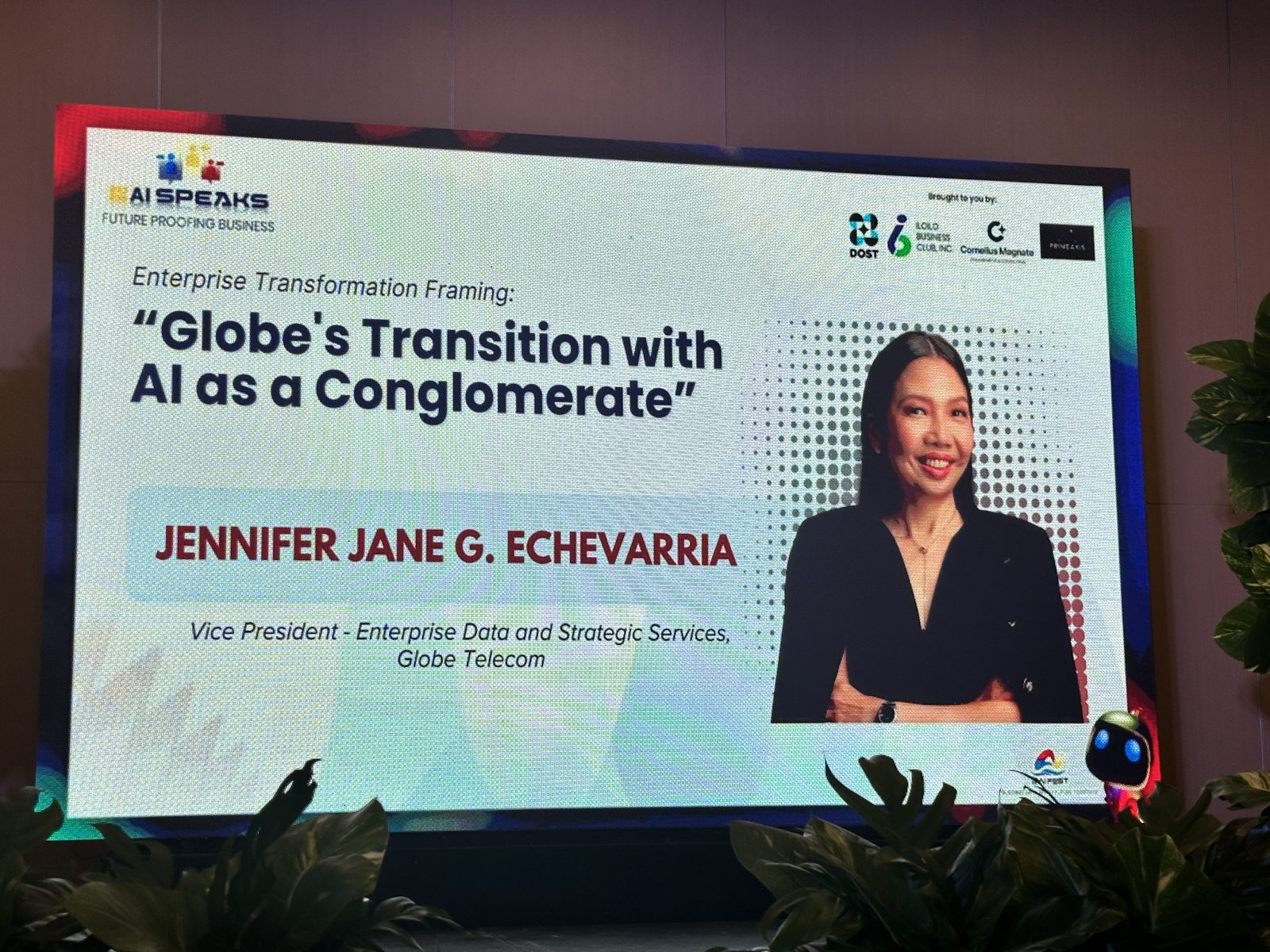
I listened to Jennifer Jane G. Echevarria speak at AI Fest 2026 in Iloilo, at a seminar called “AI Speaks,” and one number stayed with me for the rest of the day.
Echevarria is the Vice President for Enterprise Data and Strategic Services at Globe Telecom, the country’s mobile-leading operator, and she has spent close to two decades there. She opened with the Philippine AI Report 2025, a survey of 175 local organizations, and almost everyone in the room could see themselves in the numbers. About 92% of Philippine organizations have deployed AI in some form. Around 61% have backing from the CEO or C-level. And yet roughly 65% are still stuck at proof of concept, unable to move a working pilot into everyday operations.
That is the story hiding inside the numbers. Trying AI has become easy. Scaling it is the hard part that almost nobody clears. What stood out to me was how calm Echevarria was about the reason.
Why AI Pilots Fail: It Is Culture and Data, Not the Model
When a pilot stalls, the instinct is to blame the technology. Maybe we picked the wrong tool. Maybe we need a better model. Her diagnosis was almost the opposite. In her experience, the two things that kill scaling are the organization’s readiness and its data. Either the culture and skills are not ready to work with AI, or the data the AI needs is trapped in silos across different departments.
“It’s never about the fault of our AI models,” she said. “More often than not, they are performing very well.”
I have seen the same thing in the deployments we have run with Philippine businesses. The model does its job. The pilot works in the demo. Then it meets the real organization, where the data lives in five different systems and nobody agreed on who owns the process, and it quietly stops. You have probably watched this happen, di ba? The problem was never the AI. It was everything around it.
Roughly two out of three Philippine organizations that adopt AI never move past the pilot stage. The blocker is almost always culture and data, not the algorithm.
This matters because it changes what you fix. If you believe the model is the problem, you keep shopping for tools. If you believe adoption is the problem, you start working on your people and your data. This is where The 4A Blueprint matters more than the software you buy.
A Small Pilot Mistake Becomes a Mass-Market Mistake
Globe is not a small business. It serves around 67 million mobile customers and more than two million households. Echevarria’s point about scale was simple. “What we do in pilot is okay,” she said, “but when you start to scale it, this is the impact.” A mistake that looks harmless on a test group of ten becomes a very different thing when it reaches millions of people.
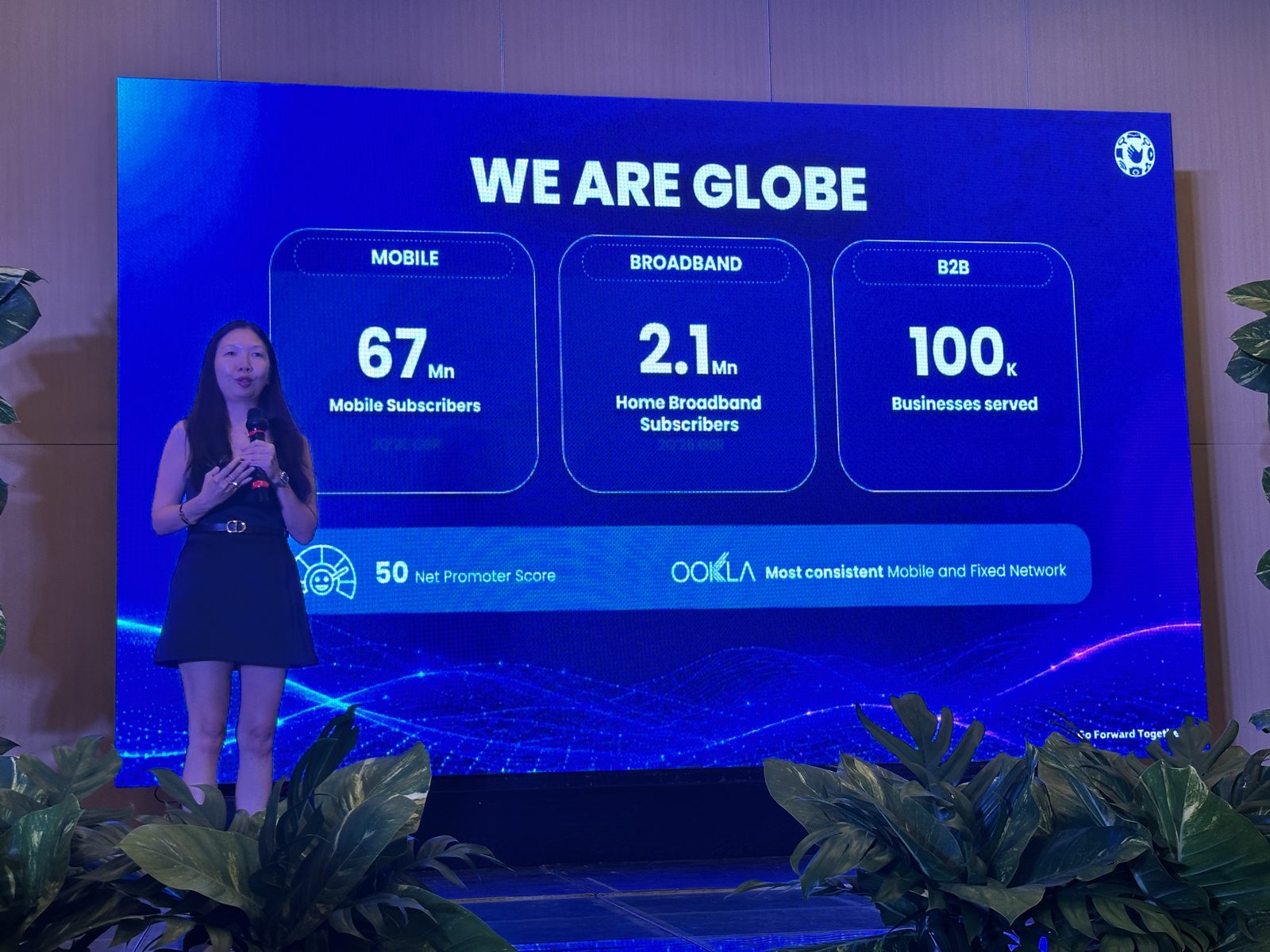 Globe’s scale, in Echevarria’s own numbers: 67 million mobile subscribers, 2.1 million broadband homes, and 100,000 businesses served. This is what a small pilot error looks like once you multiply it.
She was careful to say that telecom is not life or death the way healthcare is. But the discipline transfers cleanly to a smaller business. Judge an AI use case by what happens when it runs on everyone, not by how it looks in the demo. The demo is the easy part. The real question is what breaks when the volume is real.
For an SME, “everyone” might be every customer invoice, every support message, or every order that comes in this month. The habit is the same. Before you scale a pilot, ask what a small error looks like multiplied by your full volume, and whether you would still be comfortable.
The Foundation Took a Decade, and That Is the Point
There is one detail from Globe’s story that reframes what “foundations” even means. Echevarria said their AI journey started close to a decade ago, long before ChatGPT made headlines, with a goal that sounds almost quaint: to actually know their customers.
The twist is that about 95% of Philippine mobile customers are prepaid, so, as she put it, “there’s no face behind the data.” Globe had to use AI to infer who was a student, a retiree, or a family, and to move from scoring customers monthly to reading their needs almost in real time. She described the data growing from a pond to a lake, and then, two years ago, realizing it had become an ocean, too big for any single central team to hold.
The visible AI everyone talks about today sat on top of years of unglamorous data work. That is the part most pilots skip, and it is a big reason so many of them stall.
Treat AI as an Operating System, Not a Subscription
One line from her talk is worth putting on a wall. “You cannot look at it as, my employees have ChatGPT now, run with it.”
Buying software and adopting AI are not the same move. AI, she argued, is closer to an operating system, a combination of people, tools, and technology working together to solve a specific problem. A subscription is something you hand out. An operating system is something you build your work around.
Globe made this concrete with what they call their “AI kitchen.” Instead of every team buying its own tools, they built one shared, governed platform with the developer tools, connectors, and safeguards already in place. The invitation to staff was simple: cook whatever dish you want, but use the appliances in the kitchen. By Globe’s own count, this grew to more than 250 employees actively building their own solutions on a common toolset, behind 260-plus AI use cases.
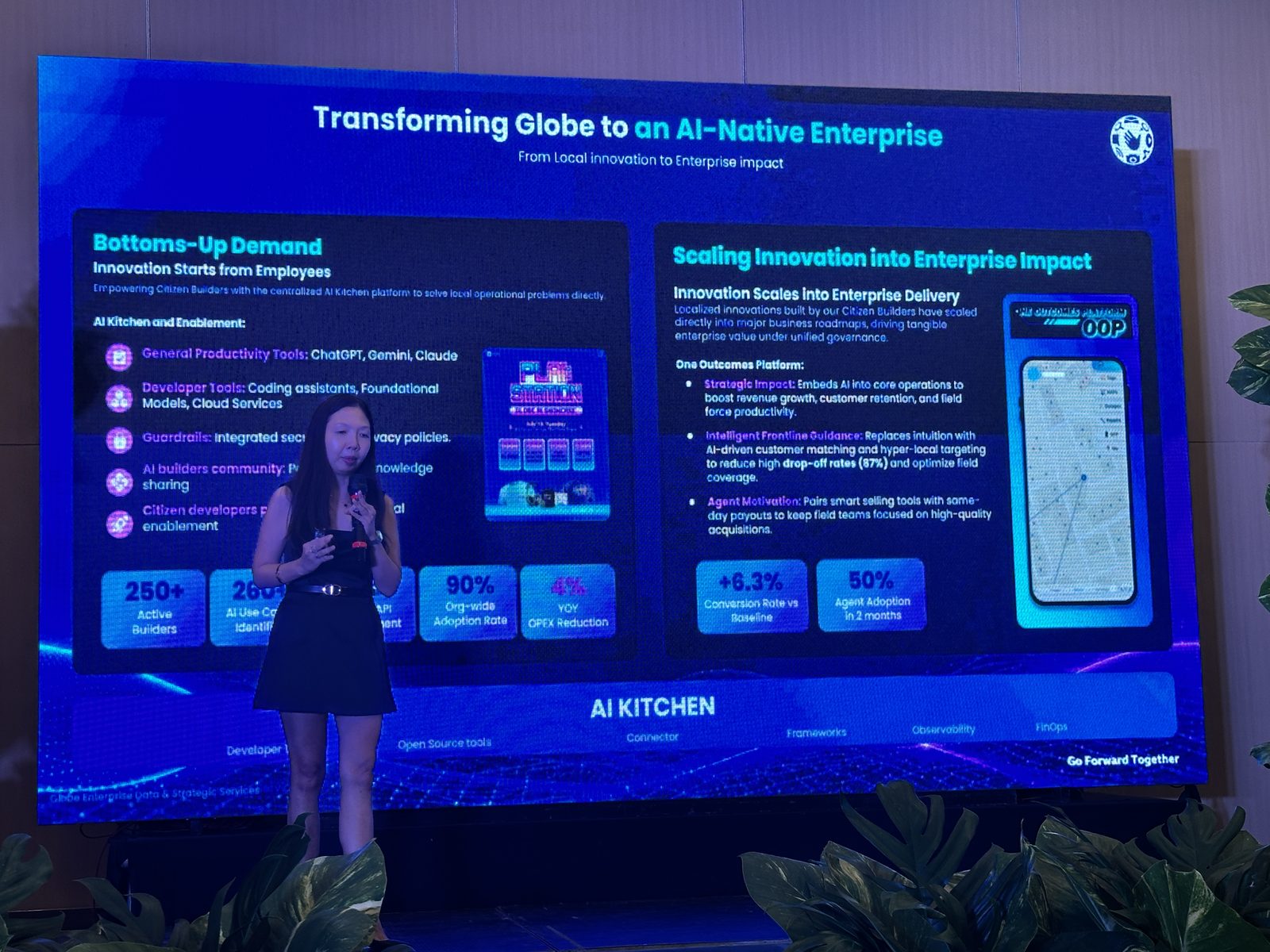 Globe’s “AI kitchen”: one shared, governed platform with the tools, connectors, and guardrails already in place. It grew to 250-plus employees building their own solutions.
What made people brave enough to build was governance, framed in a way I had not heard put so well. The fear that blocks most adoption is a quiet one: my data will end up on the internet. Globe’s answer was to treat governance as a braking system. Good brakes do not make a car slower. They are what let you drive fast with confidence. Data controls, monitoring, and clear policies were not there to slow people down. They were there to let non-experts move quickly without being afraid.
Apply AI Surgically, and Keep a Human in the Loop
The most useful rule of the morning was also the most humble. “AI is not the answer to all our problems.”
If a task is exact and rule-based, like payroll, it has no business running on probabilistic AI. As Echevarria put it, “maybe it’ll just add a zero.” Use ordinary software where the answer must be exact. Save AI for the messy, probabilistic work: reading unstructured text, predicting under uncertainty, making sense of thousands of formats that no fixed rule can cover.
Her clearest example is one almost every business will recognize. Staff can spend around 40 hours manually reading invoices that arrive in thousands of different layouts. Globe’s winning pattern was hybrid. AI reads the messy input and extracts the details. A traditional, deterministic system verifies the purchase order and guarantees the math. AI raises the fraud flags that are hard to catch by hand. And a human stays in the loop for the final decision. As she summed it up, “AI reads the messy input, but traditional data guarantees the math and rules.”
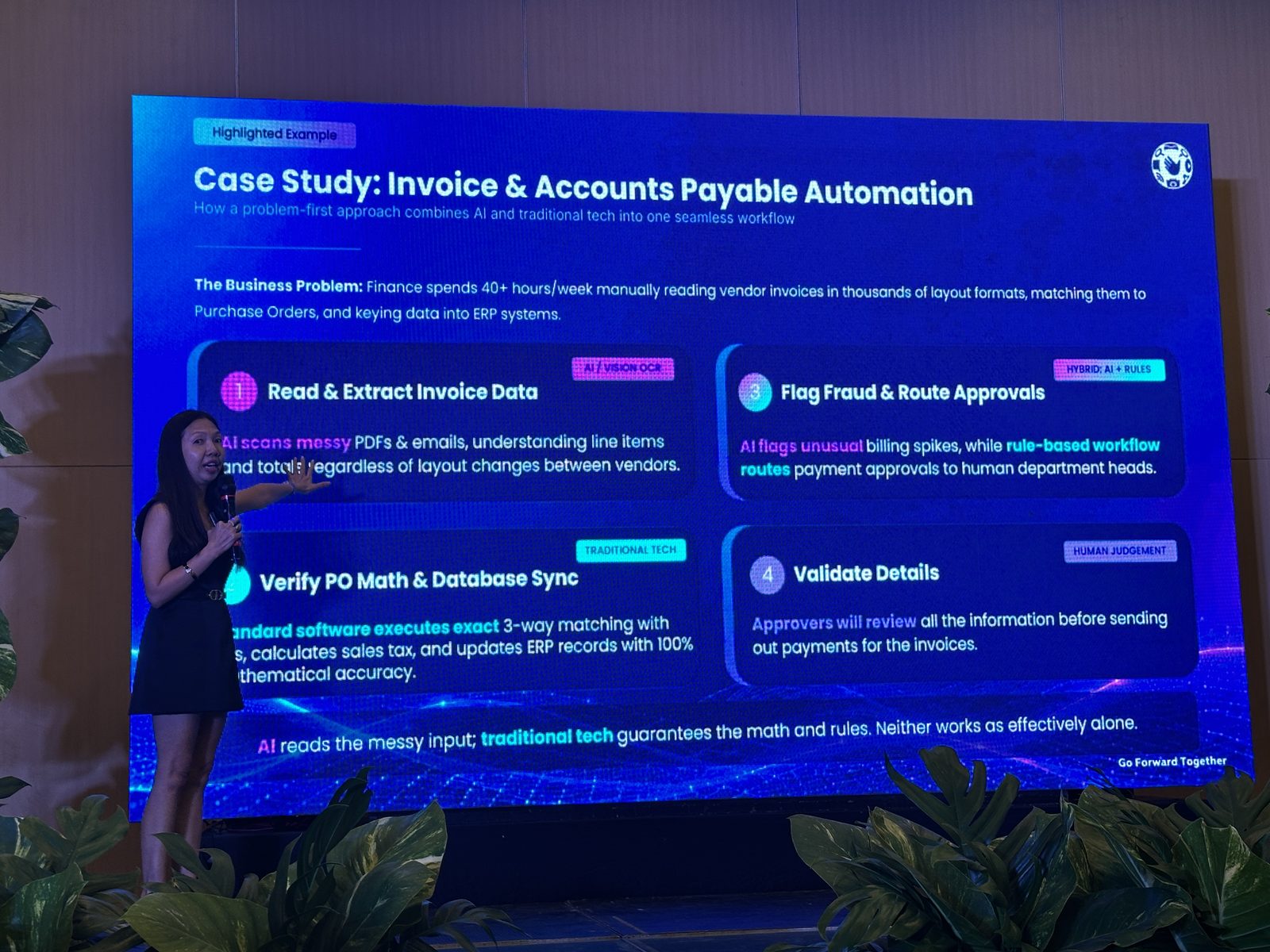 The hybrid pattern on one slide. AI reads the messy invoice, deterministic software guarantees the math, AI flags anomalies, and a human makes the final call.
Notice what AI did there. It did not replace the person. It gave them their hours back. This was the frame Echevarria kept returning to. AI is a force multiplier, not a replacement. If a task drops from a week to a day, or from ten hours to five, the real question is what happens in the hours you just freed. The answer that matters is higher-value work: visiting clients, serving customers, growing the business. Success is measured by the time you redeploy, not the headcount you remove. For any owner whose team is quietly afraid that AI means layoffs, that is the message worth repeating.
Where to Start This Week
You do not need a decade-long data program or a 260-person platform to use any of this. Globe’s scale is not the lesson. The habits are.
Pick one painful, messy task in your business, something with a lot of unstructured input and too many hours spent reading it by hand.
Map the three roles before you automate anything. Let AI read and draft. Let plain software or a simple checklist guarantee whatever must be exact. Keep a human on the final call.
Then treat your controls as brakes, not walls. Decide what data the tool is allowed to see and write it down, so your team can move fast without second-guessing every step.
That is a full week of honest work, and it is the un-sexy way the biggest telco in the country actually scaled AI. Foundations first, not model magic.
Near the end, Echevarria said the anchor never changes, no matter how fast the technology moves from generative AI to agents to whatever comes next. The purpose stays human.
“We always start human, and end human.”
That is the line I brought home. The tools will keep changing. The reason you use them should not. So before your next AI pilot, it may be worth asking a different pair of questions.
Is the model good enough?
Or is your organization ready to use it?
The first one is easy, and almost everyone can answer yes now. The second is where the 65% is decided.

Jerry Ilao
AI Business Strategist · Creator of The 4A Blueprint
Jerry Ilao is the founding president of the Philippine AI Business Association (PAIBA), co-founder and CEO of AI consulting company Olern, and co-founder of Tarkie, field-work software used by 15,000+ Filipinos. He has led 200+ digital transformation projects since 2014 and now helps Philippine businesses adopt AI through The 4A Blueprint™, his practical framework for progressing from AI assistants to automation, agents, and AI-first operations.
Sources
- Philippine AI Report 2025 (Swarm), survey of 175 Philippine organizations
- Jennifer Jane G. Echevarria, 'Globe's Transition with AI as a Conglomerate,' AI Speaks seminar, AI Fest 2026, Iloilo Convention Center, 2026-08-03