Prime Energy Built and Tested a Handbook-Based AI Assistant
Asking AI questions is where most teams start. In October 2026, Prime Energy's team went a step further: they built their own AI assistants in Microsoft Copilot, then tried hard to make them fail.
- Engagement
- Building AI Automation workshop
- Participants
- Leads, managers and specialists from operations, maintenance, finance, HR, HSSE and projects
- Industry
- Energy
- Location
- Alabang, Muntinlupa
- Workshop
- October 2026
- Facilitator
- Jerry Ilao
Handbook assistant
A Copilot assistant that answers policy questions from a sample handbook and cites the section.
Business requirements
A first draft from a template and meeting minutes, then reviewed.
Testing the assistant
Accuracy, understanding, honesty, guardrails and source verification.
Shared by participants during the October 2026 hands-on workshop.
The challenge: from asking AI to building with it
Prime Energy's team already used AI regularly. In a survey before the workshop, 16 of 18 respondents said they used it every day or a few times a week.
But many said they were using it like a search engine. When asked what held them back, the answers were specific: not knowing how to create an AI agent, how to write better prompts, and whether they could trust the answers.
That last concern shaped the day. Building an assistant is easy. Knowing when it is right is the real skill.
The workshop: build it, then try to break it
In October 2026, Jerry Ilao ran a hands-on workshop for Prime Energy in Alabang, with participants working in Microsoft Copilot on their own laptops.
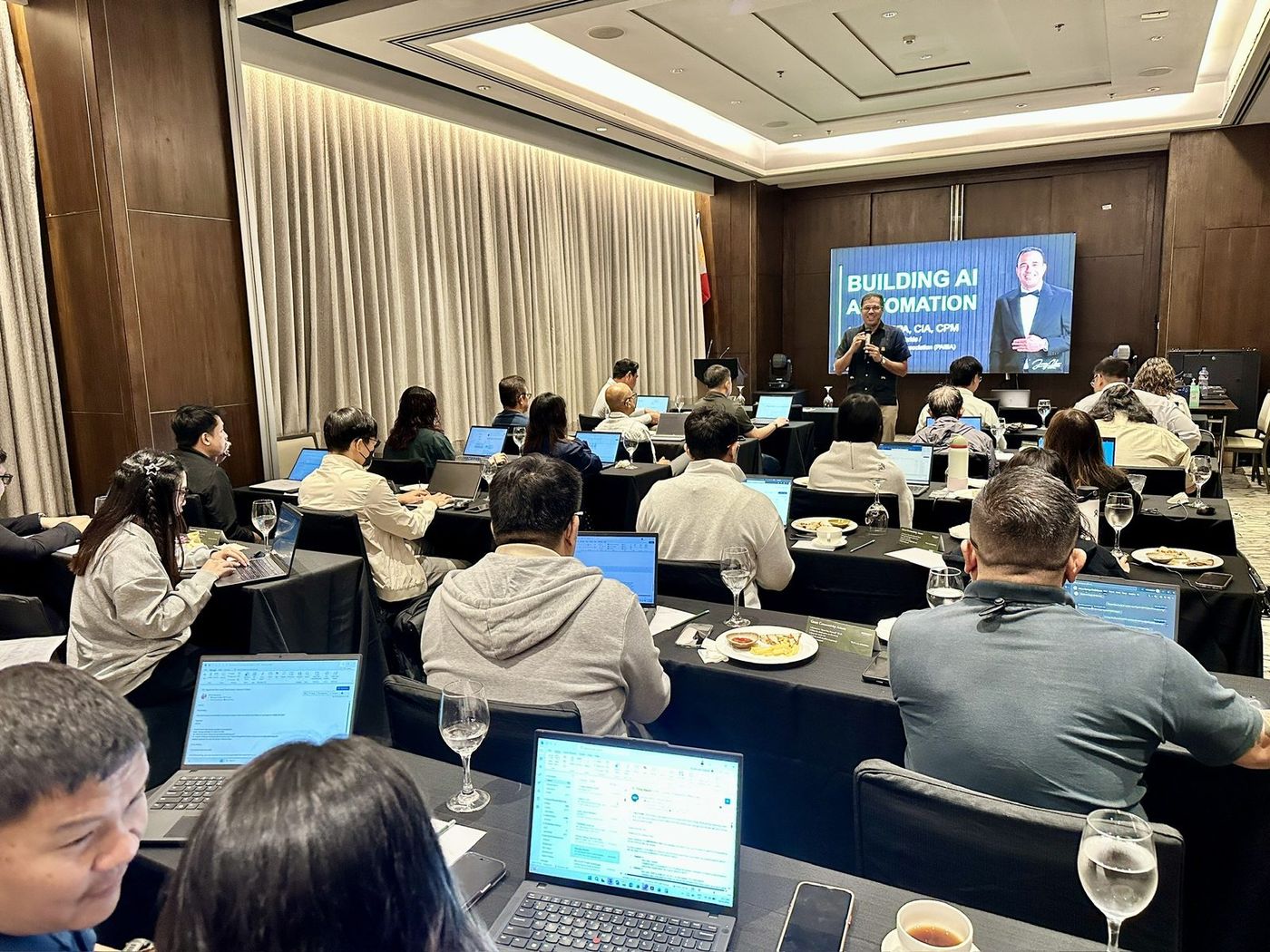
The morning covered prompting and practical business examples. The afternoon was about building assistants: giving each one clear instructions, a defined set of reference documents and rules about what it must not do.
Then came the part most teams skip: testing.
What the team built
A policy assistant that cites its source
Participants built an assistant on a sample employee handbook, used for the exercise instead of company policy. Asked a policy question, it answered from the handbook and pointed to the section it came from, so the person asking could check it.
Five tests before anyone relies on it
Every assistant went through five kinds of tests:
- Accuracy: are the answers correct?
- Understanding: does it still answer correctly when the question is worded differently?
- Honesty: when the documents do not have the answer, does it say so instead of inventing one?
- Guardrails: does it hold its rules when someone tells it to ignore them?
- Source verification: does the cited section actually say what the answer claims?
The tests also showed the guardrails at work. In one participant's assistant, the answer to a question about a specific offense sat in a table the assistant could not read.
It did exactly what its instructions told it to do: it said it could not find the answer and suggested asking HR or legal, instead of inventing one. A missing answer can be followed up. An invented one can mislead.
An assistant that says "I don't know" is safer than one that guesses. Test for both.
A business requirements document in minutes
One participant gave Copilot a blank requirements template and the minutes of the meetings where the requirements were discussed. Preparing that document by hand usually takes about half a day.
With AI, the first draft took minutes. A colleague who tried the same approach put it at three to five minutes, followed by a review.
Then came the test. Asked about something that was never decided in the meetings, the assistant answered that it was only partially discussed and not concluded. That was exactly right.
An existing report, rebuilt as an assistant
Another participant already prepared a training-compliance report with Copilot's help. In the workshop, that process became a reusable assistant, and its output was checked against the report finished the day before.
The bigger lesson: test before you trust
The team came in worried about whether AI answers can be trusted. They left with a way to find out.
A short list of test questions, run every time the instructions or documents change, turns "I hope it's right" into "we checked." That habit matters more than any single assistant they built.
And this was only Level 1
Prime Energy's team built what Copilot calls "agents." But in The 4A Blueprint, shared assistants built with reusable instructions and company knowledge are still Level 1: a person asks, the assistant helps, and the person checks the result. The level depends on how the work is organized, not on what the product is called.
Nothing was connected to the company's systems and nothing ran on its own. Each assistant still needed someone to ask the question and check the answer.
That is the point. Level 1 needs no new software, no integration project and no IT queue, and it already turned a half-day document into a draft in minutes.
There is more to gain at the next levels.
At Level 2, AI can be connected to the company's systems, so a report like the training-compliance check pulls its own data and runs on a schedule. At Level 3, an AI Agent could take responsibility for a defined job, such as tracking who is overdue for training and following up within set rules. Level 1 shows the team which processes are worth automating, and what a correct output looks like, before anyone invests in those steps.
A good Level 1 is the foundation for the higher levels. The clean data, clear calculations and tested prompts built here are what automation and AI Agents run on.
Start with Level 1. The gains are already significant, and they show you what to automate next.
Key outcomes
- Participants built their own Microsoft Copilot assistants with clear instructions, reference documents and rules.
- Every assistant was tested for accuracy, understanding, honesty, guardrails and source verification.
- The guardrails held: when an assistant could not find an answer, it said so and pointed to HR or legal instead of inventing one.
- A business requirements document that takes half a day by hand was drafted in minutes, then reviewed.
- All of these results came from Level 1, people using AI as an assistant, with room to gain more through automation and AI Agents.
What other teams can learn
A policy or procedure assistant is a manageable first build. Give it one defined set of documents, clear rules and a list of questions it must answer correctly before anyone else uses it.
Then keep the list. Every time the documents or instructions change, run the tests again.
Building the assistant is the easy part. Spend just as much time trying to break it.
For where policy and SOP assistants fit in a team's work, see AI for HR and AI for Operations.
About this case study
What did Prime Energy participants build during the AI workshop?
How did they test the AI assistants?
Is a Copilot agent a Level 3 AI Agent?
Build your first assistant. Then test it.
Hands-on workshops where your team builds AI assistants on its own documents, and learns how to check them before anyone relies on them.
Explore AI agents workshops → Discuss a knowledge-assistant pilot with Tellix →