How PHINMA's Finance Leaders Tested AI on Real Reporting Work
PHINMA Corporation is a Philippine conglomerate with businesses in education, construction materials, property and hospitality. Its finance teams close the books, consolidate results and report to management and the board across all of them.
- Engagement
- AI Workshop for Business Leaders, tailored for finance
- Participants
- Controllers, accounting managers, FP&A, treasury, credit and finance-systems leaders across the group
- Location
- Makati City, Philippines
- Workshop
- October 2026
- Facilitator
- Tellix-certified AI trainer
Monthly performance analysis
An accounting officer ran the monthly performance analysis through AI with the workshop prompt, including review.
Days Sales Outstanding report
A credit head drafted the monthly report on how long customers take to pay.
Quarterly board pre-read
A portfolio manager let AI do the number crunching, then added the board and market context.
Participants' own estimates from the workshop survey, including review and corrections.
The challenge: already using AI, but not yet on the core work
The group's finance leaders were not new to AI. In a survey before the workshop, 22 of 23 respondents said they already used AI tools every day or a few times a week, mostly Copilot and ChatGPT.
But much of that use sat around the edges of finance work: polishing emails, drafting letters, summarizing information, doing research. Much of the work that consumes a finance team's month was still manual.
When asked where they wanted AI to help next, they listed the core of the job:
- Reconciliations, from GL accounts to bank balances and inventory counts
- Monthly financial reports, budget versus actual and variance explanations
- Budget files that update when assumptions change
- Consolidation and analysis across business units
- Monitoring receivables, payments and bank exposure
The question for the workshop was practical: can AI do real finance work, on real files, in a way a controller would sign off on?
The workshop: bring your own report
In October 2026, a Tellix-certified AI trainer ran a full-day, hands-on workshop in Makati for the group's finance, controllership and accounting leaders.
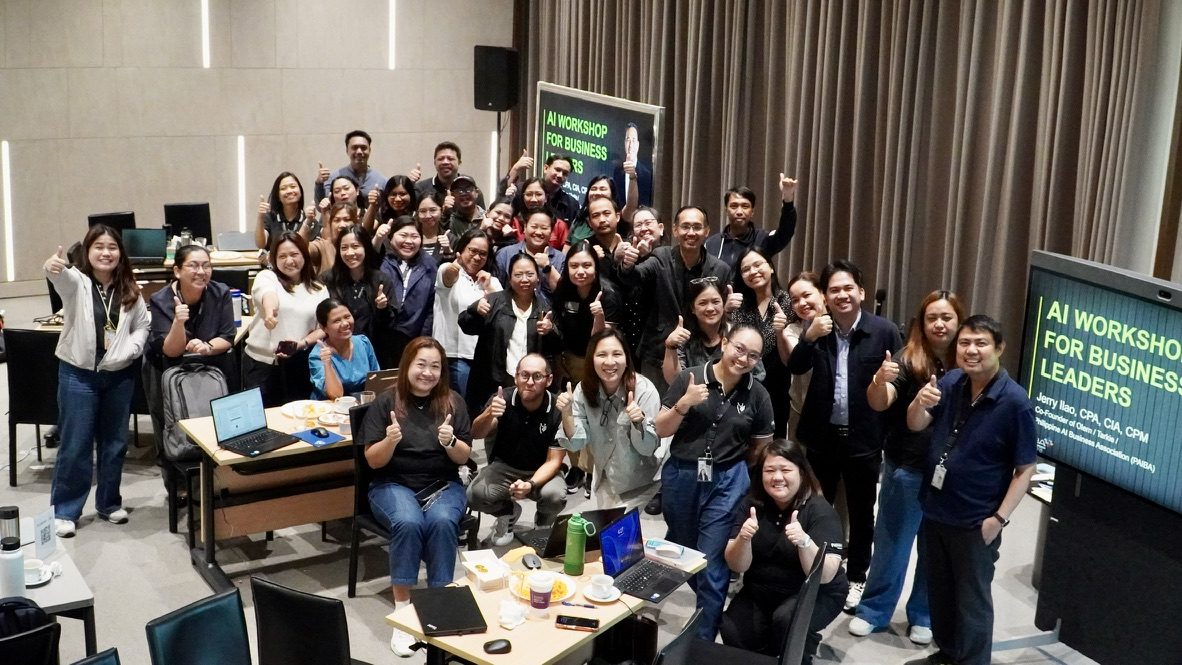
Participants worked in Microsoft Copilot, the AI tool their company had approved, so anything they learned could be used at their desks the next day. The session covered:
- A structured way to write prompts: role, task, context, format and constraints
- Deep research and scenario analysis for finance questions
- A live bank-reconciliation demo
- A performance-analysis prompt designed to work on almost any management report
- Hands-on time applying all of it to participants' own files
That last part mattered most. Instead of watching AI work on someone else's data, participants could test it on reports they already knew, and judge the output against their own standards.
What the teams found
1. A two-day monthly analysis, drafted in eight minutes
An accounting officer used the workshop's performance-analysis prompt on a monthly report. The prompt asks AI to work through the data, then produce KPIs, charts, key insights and a management summary on separate sheets, without changing the original worksheets.
Work that normally takes about two days took eight minutes, including review. The officer rated the result better than the usual output.
2. The DSO report, from half a day to five minutes
A credit head from one of the group's companies tested the monthly Days Sales Outstanding report and analysis, the report that shows how long customers take to pay. It normally takes half a day. With AI, the draft took five minutes. In the credit head's words, the result was "very fast and concise."
3. The quarterly board pre-read: AI does the numbers, people add the context
A portfolio manager tested the board pre-read that explains each business unit's results after quarter end. It usually takes two to four days, mostly encoding and reconciling between management and statutory formats. With AI, it came down to four to five hours.
The manager was candid about where AI stopped. It was strong on the number crunching and the analysis, but it could not know what was said in board meetings, what the CEOs were thinking or what was happening in the market. That part still came from the manager.
"I need to do less of the number crunching analysis. I need to do more of the real world validation."
The next step discussed in the session was to give AI that context too, such as meeting minutes and field reports, so the next draft starts closer to the final.
4. Trial balance to financial statements, checked and correct
During a 30-minute hands-on exercise, one participant gave AI the trial balance, plus their existing financial statements as a guide for grouping accounts. AI drafted the financial statements. Asked on the spot whether they were right, the participant confirmed it: the format was good and the figures were correct.
For a finance team, that is the starting point. Let AI handle the grouping and formatting, and spend the time saved on the analysis management actually reads.
5. Bank reconciliation in under five minutes, on sample data
In a live demo, AI reconciled a month of sample cash-book and bank-statement entries in under five minutes. It sorted each item into matched, ambiguous or timing differences and suggested a follow-up for each. A participant estimated 15 to 30 minutes to do the same set by hand. A real month will have far more entries and harder exceptions, so the AI's matches are a starting point: an accountant still reviews them before anything is recorded in the books.
The bigger lesson: from preparing numbers to validating them
Across every exercise, the pattern was the same. AI compressed the mechanical part of finance work: encoding, grouping, matching, calculating and formatting. What it did not replace was the judgment that makes a report trustworthy: knowing which number looks wrong, which adjustment is missing and what the board actually needs to hear.
Participants noticed something else. The quality of the output depended heavily on the input. As the portfolio manager put it in the survey, "Both having the right prompts and data sets make a big difference in reducing time needed and improving output."
And this was only Level 1
Every result on this page came from Level 1 of The 4A Blueprint: a finance professional doing the work, with AI as an assistant. Nothing was connected to the accounting system and nothing ran on its own. Each report still needed someone to upload the file, run the prompt and check the output.
That is the point. Level 1 needs no new software, no integration project and no IT queue, and it already turned two days of analysis into minutes.
There is more to gain at the next levels.
At Level 2, AI can be connected to the accounting system, so a monthly analysis prepared the same way after every close pulls its own data and runs automatically. At Level 3, an AI Agent can monitor receivables or variances and flag what needs a finance manager's attention. Level 1 shows the team which reports are worth automating, and what a correct output looks like, before anyone invests in those steps.
A good Level 1 is the foundation for the higher levels. The clean data, clear calculations and tested prompts built here are what automation and AI Agents run on.
Start with Level 1. The gains are already significant, and they show you what to automate next.
What they asked next: access and audit trails
By the end of the day, the questions had moved from "can AI do this?" to "how do we run this safely?" These are questions every finance team should ask before it uses AI on sensitive data at scale, and two came up in the room:
- Sharing without exposing. Can a team share a file so colleagues see totals they need, but not individual salaries?
- Protecting data integrity. If several people work on a shared file, how do you trace who changed what?
The honest answer is that a prompt alone does not solve either one. Telling AI "do not reveal salaries" is not access control, and asking it to keep a log is not an audit trail. They need to be designed into the setup: what data each person can reach, which tools are approved and what gets logged. That is the work that turns a successful workshop into something a finance team can rely on every month.
What participants said
"Result is very fast and concise."
"Both having the right prompts and data sets make a big difference in reducing time needed and improving output."
Key outcomes
- The group's finance, controllership and accounting leaders applied AI to their own monthly and quarterly reports, in the company's approved tool.
- A monthly performance analysis went from about two days to eight minutes, and a DSO report from half a day to five minutes, by participants' own estimates.
- A quarterly board pre-read went from two to four days to four to five hours, with the manager adding the board and market context AI could not see.
- A participant drafted financial statements from a trial balance within a 30-minute exercise and confirmed the figures were correct.
- All of these results came from Level 1, finance professionals using AI as an assistant, with room to gain more through automation and AI Agents.
- The team identified the next step beyond prompting: access rules and audit trails for finance data.
What other finance teams can learn
The most useful AI test for a finance team is not a demo. It is a report you already know: one you prepare every month, with a version you already trust.
Give AI the same data. Compare the draft with the reviewed version. Then decide which part of the work AI should own, which part your people should own, and what controls the setup needs before it runs every month.
AI can prepare the numbers. Finance still decides what they mean.
For a map of where AI fits across a finance function, from analysis and reporting to collections, close and controls, see AI for Finance & Accounting in the Philippines.
About this case study
What did the finance team work on during the AI workshop?
Who attended the workshop?
How much time did participants save with AI?
Bring your reports. See what AI does.
Hands-on AI workshops for finance, controllership and accounting teams, built around the reports your team prepares every month.
Explore AI workshops for finance teams → Discuss AI for finance reporting with Tellix →