How Lapanday Moved From AI Awareness to Practical Business Action
Lapanday Foods Corporation is a Philippine agribusiness company that grows, supplies, and exports bananas and pineapples from Mindanao to international markets across Asia and the Middle East. The company manages its operations across production, quality, packaging, cold-chain management, and export distribution.
- Engagement
- AI Workshop for Executives and Managers
- Participants
- CEO, department heads, and members of the executive and management team
- Industry
- Agriculture / Agribusiness
- Workshop
- February 2026
- Facilitator
- Jerry Ilao
An "eye-opener" for management
How Lapanday's IT head described the workshop, months after the session.
Non-developer → operational app
A manager with no software-development background built an application with AI assistance, for a real requirement in the packing operations.
~20% faster development
In some development activities, according to Lapanday's IT head.
The challenge: knowing about AI wasn't the same as knowing what to do with it
Before the workshop, Lapanday Foods Corporation's leaders were already aware of artificial intelligence. Some had encountered AI through YouTube, the news, and tools already available inside the organization.
But awareness had not yet translated into a clear understanding of how broad AI's business applications could be, or where the company should begin.
In a follow-up interview months after the workshop, Lapanday's IT head explained that they already knew about AI before the training, but had not fully grasped how powerful and far-reaching the technology could be.
That is a common challenge for management teams today. The question is no longer "Have we heard about AI?" It is: "What does AI actually mean for our business, our departments, and the way we work?"
The workshop: helping leaders see AI through a business lens
In February 2026, Jerry Ilao conducted a practical AI workshop for Lapanday's executive and management team, including its CEO and department heads.
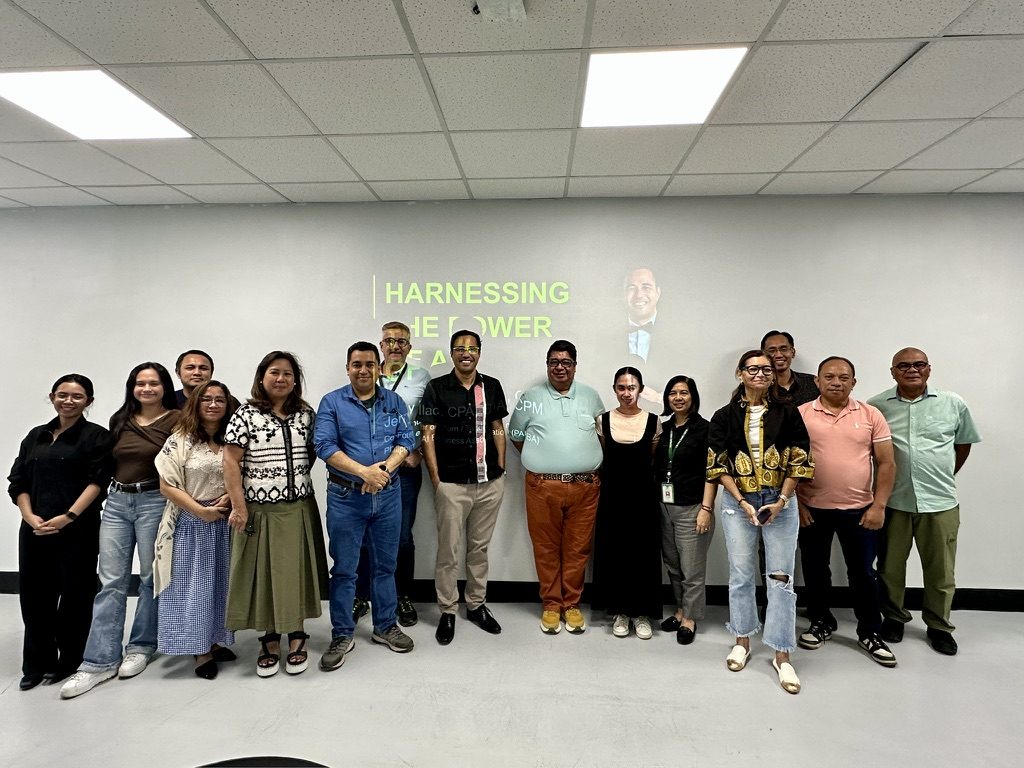
The objective was not simply to demonstrate AI tools. The workshop helped leaders understand the range of what AI can now do and begin connecting those capabilities to actual business problems. Instead of leaving with a list of interesting AI applications, managers could begin asking:
- Where can AI save us time?
- What work can now be done differently?
- Which problems no longer need to be solved the old way?
- What can people in the business now do that previously required specialized technical resources?
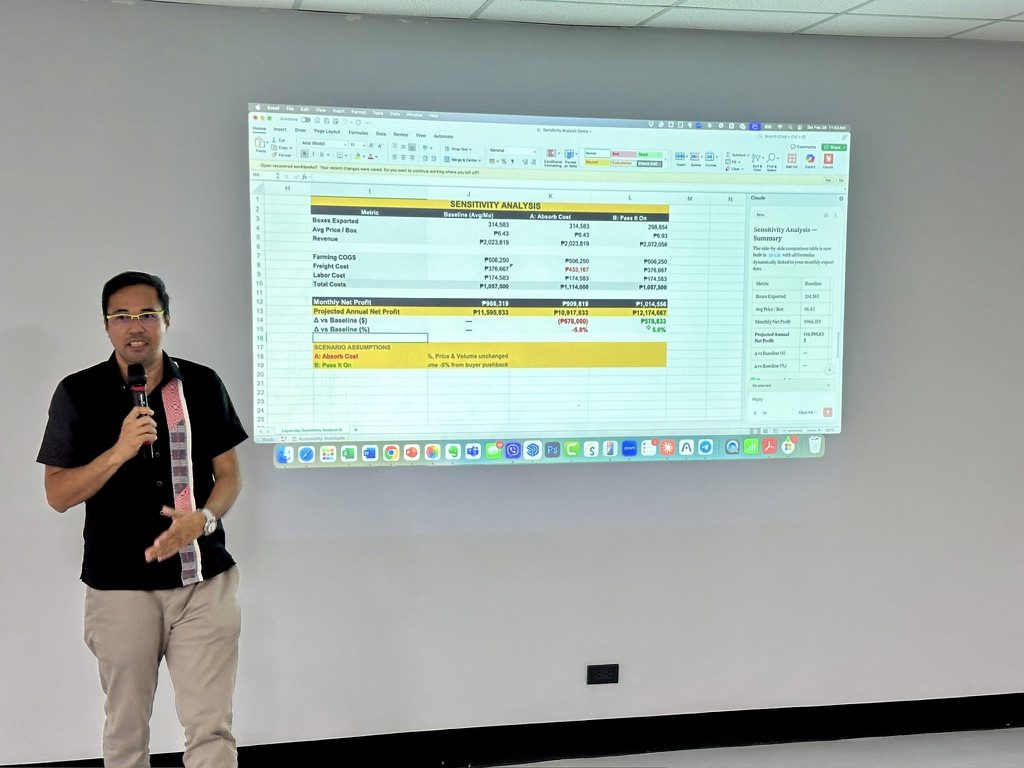
Months later, Lapanday's IT head described the training as an "eye-opener" for management, saying it helped them better understand how broad and powerful AI had become.
What happened after the workshop
1. A non-developer turned a real business requirement into an application
One of the clearest examples came from a manager whose background was in finance rather than software development.
Using an AI-assisted development platform, he created an application for an actual operational requirement in Lapanday's packing operations. The application was designed to monitor materials issued and used during packing and help track finished products through the process. (For the full map of where AI helps an operations team — from reporting and SOPs to exception monitoring and field visibility — see AI for Operations in the Philippines.)
According to Lapanday's IT head, instead of immediately allocating one of the company's developers to build the requirement from scratch, the business user was able to develop and begin implementing the solution himself. The IT head also connected the idea of using AI this way to what the participant had learned from the workshop.
The important lesson is not that IT became optional. It is almost the opposite. When business users gain the ability to build applications with AI, IT review, security, integration standards, and governance become even more important, particularly when a solution may connect with core enterprise systems.
What changed was something more practical:
The queue got shorter.
A real business requirement could be acted on by the person who understood the problem closely, without first waiting for an available developer slot. IT could continue focusing limited technical resources on higher-priority systems while providing the appropriate oversight.
AI did not eliminate the need for developers. It expanded who could participate in solving business problems.
2. Developers were also working faster with AI
AI was creating value on the technical side as well. Lapanday's IT head estimated that AI had increased development speed by around 20% in some development activities.
Instead of coding everything manually from scratch, developers could use AI-generated code or suggestions as a starting point, then review, refine, edit, and integrate the output into their applications.
The distinction is important. AI was not replacing software-development expertise. It was helping skilled developers move faster. For a technology team already handling major system requirements, even incremental improvements in development speed can create meaningful additional capacity.
3. The bigger change was in how management saw AI
The most important workshop outcome may have been neither the application nor the productivity estimate. It was the change in understanding.
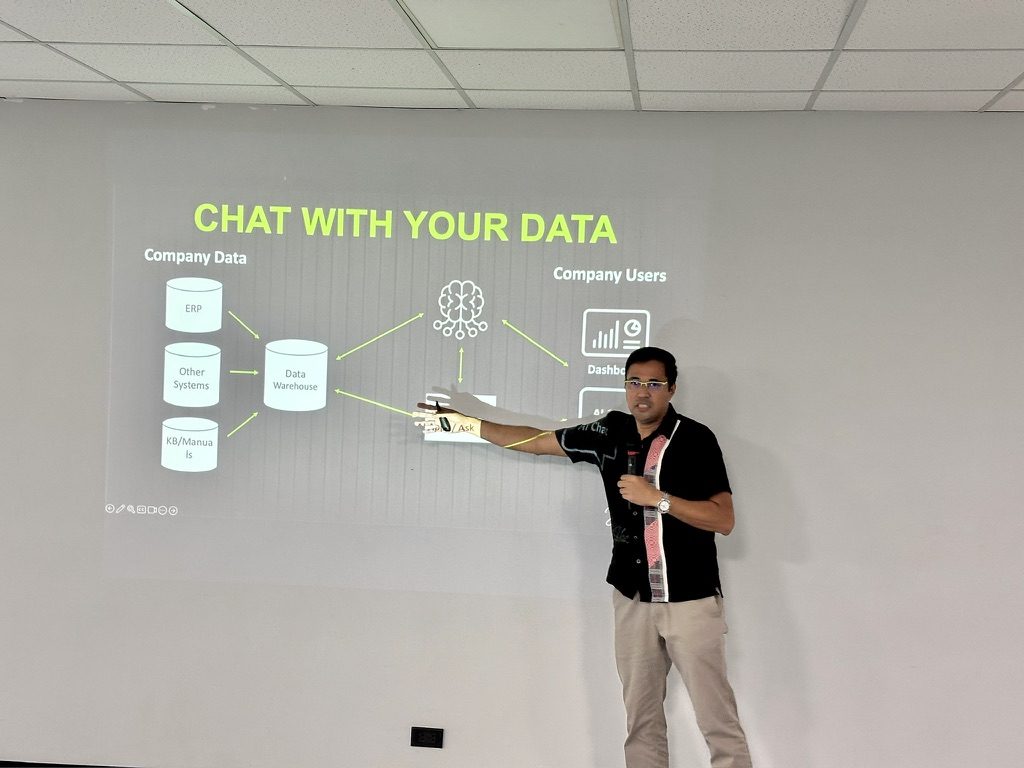
In the follow-up interview, Lapanday's IT head explained that the management team came away with a much clearer appreciation of the breadth of AI, from everyday productivity to programming and entirely new ways of creating solutions. He summarized the impact simply:
"It was an eye-opener for us and for management."
That shift matters because organizations cannot identify good AI opportunities if their leaders still think of AI primarily as a chatbot. Once management understands what is possible, the conversation changes from "Should we use AI?" to "Where should we use it first?"
The result: from AI awareness to practical experimentation
Lapanday's experience shows why business AI training should go beyond teaching people how to prompt ChatGPT. The progression was more meaningful:
AI awareness → management understanding → business experimentation → a real operational application → faster work for technical teams
The workshop did not prescribe every AI project Lapanday should pursue. Instead, it helped give its leaders a clearer lens for recognizing where AI could change the way work gets done. And in at least one case, that understanding translated into an actual solution created by the person closest to the business requirement.
Key outcomes
- Lapanday's CEO, department heads, and management team gained a clearer understanding of AI's practical business applications.
- A manager without a software-development background used AI-assisted development to create an application addressing a real operational requirement.
- The solution reduced the need for that requirement to immediately compete for scarce IT development capacity.
- Lapanday's IT head estimated AI was helping developers work around 20% faster in some development activities.
- The workshop helped shift the management conversation from general AI awareness toward practical business possibilities.
What other management teams can learn from Lapanday
Companies sometimes assume they need a complete AI strategy before managers can begin creating value. Lapanday's experience suggests a different starting point.
First, leaders need to understand what has become possible. Then the people closest to business problems can begin recognizing opportunities that would otherwise remain invisible.
The goal of a practical AI workshop is therefore not merely to teach a tool. It is to help leaders look at familiar work and ask:
"Now that AI exists, would we still solve this problem the same way?"
That is where meaningful AI adoption begins.
For a map of where this kind of practical AI fits across a farm or agribusiness — 15 use cases from farm records and crop monitoring to packing, cold chain, and management Agents — see AI for Agriculture & Agribusiness in the Philippines.
About this case study
Who attended the Lapanday AI workshop?
What happened after the Lapanday AI workshop?
What was the main impact of the workshop on management?
See what your business can now do differently
Jerry Ilao's corporate AI workshops are designed for executive and management teams that want to move beyond AI awareness and begin identifying practical applications inside their own businesses. The sessions help leaders understand what AI can do today, apply it to real business situations, and identify opportunities relevant to their departments and organization.
The goal isn't simply to know more about AI. It's to see what your business can now do differently.