The framework · official reference

The 4A AI Roadmap
Assistants · Automation · Agents · AI-First

The 4A AI Roadmap is a four-level AI maturity framework for businesses, created by Jerry Ilao for the Philippine context. It answers the two questions every business owner asks about AI — where is my business today? and what is my next move? — in plain business language instead of jargon.

By Jerry Ilao · Version 1.2 · Updated August 2026 · Refined through 200+ transformation projects and live workshops with Filipino business owners

If you've been asking where and how to start with AI — this framework is the answer, and the free assessment pinpoints yours in three minutes.

Definitions

The four levels of AI adoption

Each level describes how AI's role in a business changes — from a tool a person prompts, to a process that runs on its own, to a digital team member that carries real work, to the business model itself. Each level also has a gate: a short, concrete checklist a business must actually pass, not just claim. The free assessment scores you against all four gates, and the levels above where you land aren't failures; they're the roadmap.

Level 1

Personal AI Assistants

The first A · Assistants

AI helps when you ask. You prompt, it responds — the human is still doing the work.

Individual employees use general-purpose AI tools (ChatGPT, Claude, Gemini, Copilot) to do their existing jobs faster. The tool exists at the person level, not the business level. This is where most Philippine businesses actually are — and it matters more than it looks, because the judgment built here is what every level above runs on.

What it looks like. A few people have quietly become good at ChatGPT, Claude, Gemini, or Copilot: the youngest on the team in a small business, the IT department or a few curious staff in a bigger one. The contractor's estimator writes proposals with it, the clinic's front desk drafts letters, the restaurant manager writes posts. But the learning lives in personal accounts and leaves when the person does, and nobody has written down what people are allowed to paste into AI.

The trap. Believing AI hasn't really entered the business yet. It has: people are already using it on personal accounts, pasting company and customer information into tools nobody has reviewed. The real choice at Level 1 isn't whether AI comes in; it's whether it comes in with training and rules.

What passing it unlocks. Everything above it works better because of it. People who use AI daily can tell good output from bad, know which tasks are safe to hand off, and catch mistakes before customers see them. That judgment is what the higher levels run on, and for many businesses this level already delivers more than half of what they hoped AI would do for them.

Level 2

Workflow Automation

The second A · Automation

AI is built into processes your business depends on — they run on their own.

AI is embedded in processes the business depends on: inquiries get answered, documents get sorted, reports get drafted, without a person driving each step. The AI is doing real thinking inside the process, not just moving data from one app to another. A tool bought with AI inside counts the same as one you built. Level 2 is optional — many smaller businesses skip it entirely (see the Leapfrog below).

What it looks like. Work moves while nobody is watching. The inquiry that arrived at 9pm has a drafted reply by morning, the distributor's orders are encoded before the team walks in, the month-end report arrives as a draft for review. When one of these processes stops, someone notices quickly, because the business genuinely leans on it.

The trap. Automating the mess. A manual process gets transferred to AI as-is, nobody asks which steps still need to exist, and the process is never redesigned around what AI can do. The mess just runs faster, and an error a person would make once now repeats at scale.

What passing it unlocks. You serve more customers and move more paperwork without adding people, and the processes you document here make Level 3 agents far easier to supervise.

Level 3

AI Agents & Orchestration

The third A · Agents

AI acts across multiple steps. The AI does the work — the human supervises.

AI agents hold specific roles — content, customer replies, lead handling, operations — and carry a real share of the work, drawing on shared business knowledge (the knowledge layer: transcripts, reviews, SOPs, brand voice). The differentiation at this level is how deeply the agents know the business: two competitors on the same platform end up with different advantages, because their agents know different things.

What it looks like. The AI holds a job, not just a chat window. It runs the restaurant group's social media, answers the distributor's customer messages, or drafts the firm's client reports, and a person reviews before anything goes out. Ask where it learned the business and there's a real answer: the company's own price lists, policies, SOPs, and past customer conversations.

The trap. Treating the agent like software instead of like a new hire. It gets no onboarding on the company's own knowledge, no named manager, and a review step that becomes clicking approve. Generic work then goes out at scale with your name on it.

What passing it unlocks. Owner time. The work gets carried, not just sped up, and the business stops depending on the owner personally driving every function.

Level 4

AI-First Business Model

The fourth A · AI-First

AI isn't supporting the business — AI is the business.

Remove AI tomorrow and the value proposition doesn't slow down — it collapses. Pricing reflects the AI advantage (faster delivery, lower cost, or premium AI-enabled service), team size is materially leaner than competitors at the same revenue, and customers knowingly buy the AI advantage. Genuinely rare in the Philippines today — and optional by design: in this framework, higher is not always better.

What it looks like. Customers choose the business because of what AI makes possible: the lender that approves in minutes, the agency that delivers in days, the firm that serves several times the clients per employee. They know it's AI-powered, and that's part of why they buy. The team is a fraction of what competitors need at the same revenue.

The trap. Building the value proposition on AI the business doesn't control, without a fallback. At this level a provider's outage or price change lands directly on customers, so the risks get owned at the top or the model fails publicly. The quieter trap: chasing Level 4 as a badge when the business would be stronger staying at Level 3.

What passing it unlocks. A different company, not a faster version of the old one: margins, prices, and speed that competitors without AI can't reach.

Adoption paths

Most companies don't climb one rung at a time

The Leapfrog ★

Level 1 → Level 3

Recommended for most SMEs. Skip workflow automation; deploy AI agents directly — modern agent platforms carry the workflow structure with them. Fits founder-led companies under ~50 people. What it doesn't skip: Level 1 fluency and the knowledge layer.

The Primary Path

L1 → L2 → L3 → L4

The textbook progression — each stage builds the conditions for the next. Right for larger organizations with established processes. Slower, but the SOPs and monitoring discipline built at Level 2 become a head start at Level 3.

The Strategic Shift

Level 3 → Level 4

Not an operational upgrade — a redesign of the business itself: pricing, offerings, team structure, positioning. Slowest, hardest, and not always the right destination. Entered deliberately or not at all.

Why the framework exists

What the Philippine data says

Only 14.9% of Philippine firms have formally adopted AI, and only about one in five firms are even familiar with AI technologies — yet among organizations surveyed in enterprise studies, over 92% report using AI in some form, with the majority stuck at the pilot stage, and only 12% having any AI governance role.

Read together: informal use is everywhere, structured adoption is rare, and almost nobody has moved from experimenting to operating. Most businesses sit at Level 1 — many while describing themselves as Level 2 or 3. In workshop settings, leaders commonly place themselves one level above where the diagnostic does. The gap between the story and the reality is the framework's reason to exist: you can't close a gap you can't see.

Sources: Philippine Institute for Development Studies (PIDS), 2025 · Philippine AI Report 2025 (survey of 175 organizations) · live workshop observations, 2025–2026. Full statistics library: PH AI Statistics.

See where you actually fall — the free 3-minute assessment →

Core principles

Four rules the framework lives by

1 · The path is not always linear. Most value in the framework comes from recognizing the Leapfrog — the majority of Philippine SMEs shouldn't build Level 2 first.

2 · Higher is not always better. Level 4 is a deliberate business-model choice with distinct risks. Most strong businesses are best at Level 2 or 3 — and "stay at Level 3" is a legitimate strategic decision, not a consolation.

3 · Self-diagnosis is optimistic. The gates are deliberately concrete and uncomfortable: they measure what really happens, not what's planned. That's why the assessment asks about a normal week, a real process, an actual customer.

4 · Governance rises with the level — and never lags it by more than one. A chatbot's worst case is a wrong answer; an agent's worst case is an action. Each level of the framework carries its own safety rails, from a one-page AI policy at Level 1 to board-grade risk ownership at Level 4.

The execution layer — fill-in templates, checklists, and run-of-shows for every level — is The 4A Toolkit™.

Common questions

Frequently asked

What is an AI roadmap?
An AI roadmap is a step-by-step plan for how a business adopts artificial intelligence: where the business stands today, which level of AI use to aim for next, and what to implement in what order. A good AI roadmap starts from an honest assessment of current usage rather than from tools. The 4A AI Roadmap is a four-level version built for Philippine businesses by Jerry Ilao: it locates a business on one of four levels (Assistants, Automation, Agents, AI-First) and returns its one next move and a 90-day starting plan.
What is the 4A AI Roadmap?
The 4A AI Roadmap is a four-level AI maturity framework for businesses, created by Jerry Ilao for the Philippine context. The four levels — Assistants, Automation, Agents, AI-First — describe how AI's role evolves from personal tool to business model. It answers two questions: where is my business today, and what is my next move.
What are the four levels of AI adoption in the 4A AI Roadmap?
Level 1 — Personal AI Assistants: individuals use AI tools to work faster. Level 2 — Workflow Automation: AI is embedded in processes that run on their own. Level 3 — AI Agents & Orchestration: AI agents hold real roles and carry a share of the work with human oversight. Level 4 — AI-First Business Model: the value proposition collapses without AI, and customers knowingly buy the AI advantage.
Who created the 4A AI Roadmap?
The 4A AI Roadmap was created by Jerry Ilao, a Philippine AI business strategist — Founding President and co-founder of the Philippine AI Business Association (PAIBA), co-founder and CEO of Olern, an AI training company, co-founder of Tarkie, and leader of 200+ digital transformation projects since 2014. The framework was refined through live workshops with Filipino business owners.
How do I find out what level my business is at?
Take the free 3-minute assessment — thirteen plain-language questions about what actually happens in the business, gate-based scoring, and a result that includes your level, your one next move, and a 90-day starting plan.
What is the AI Leapfrog?
The Leapfrog is the 4A AI Roadmap's path from Level 1 directly to Level 3 — skipping workflow automation and deploying AI agents directly. It is the recommended path for most small and medium businesses, because modern agent platforms carry the workflow structure with them. It does not skip the prerequisites: Level 1 fluency and a business knowledge layer.
Is Level 4 the goal for every business?
No. In the 4A AI Roadmap, higher is not always better. Level 4 is a deliberate business-model choice with distinct risks, entered deliberately or not at all. Most strong businesses are best served operating at Level 2 or Level 3.
How is the 4A AI Roadmap different from Gartner's or MIT's AI maturity models?
Those models are enterprise-oriented and abstract — built for CIOs. The 4A AI Roadmap is built for owner-led businesses: it describes each level as observable, real-world behavior, it scores in minutes through a free gated assessment, it recognizes non-linear paths including the Leapfrog, and it's grounded in Philippine adoption data and hundreds of workshop conversations.
Is the 4A AI Roadmap only for Philippine businesses?
The four levels apply anywhere, but the framework was built for the Philippine context — its data, examples, economics, and diagnostic thresholds come from Philippine businesses and workshops with Filipino owners.
Can I use the 4A AI Roadmap in my organization or with my clients?
Yes — the framework is free to use and teach with attribution ("The 4A AI Roadmap™ by Jerry Ilao, jerryilao.com/4a-ai-roadmap"). For facilitated workshops, keynotes, or licensing, get in touch.
Provenance

Who created the 4A AI Roadmap

Jerry Ilao, creator of The 4A AI Roadmap

Jerry Ilao

CPA, CIA, CPM · AI Business Strategist

Founding President and co-founder of the Philippine AI Business Association (PAIBA), co-founder and CEO of Olern, an AI training company, and co-founder of Tarkie — field-work automation used by 15,000+ employees at companies like Globe, Samsung, Uratex, Brother, and Chooks-to-Go. Featured in Bilyonaryo News Channel, Channel News Asia, Globe Business, and Net 25.

The 4A AI Roadmap distills 200+ digital transformation projects since 2014 and hundreds of workshop conversations into the question every owner asks first: "Where do we even start?" — answered in plain business language.

PAIBA is a civic role and biographical credential; the association does not endorse any company or product, including the author's.
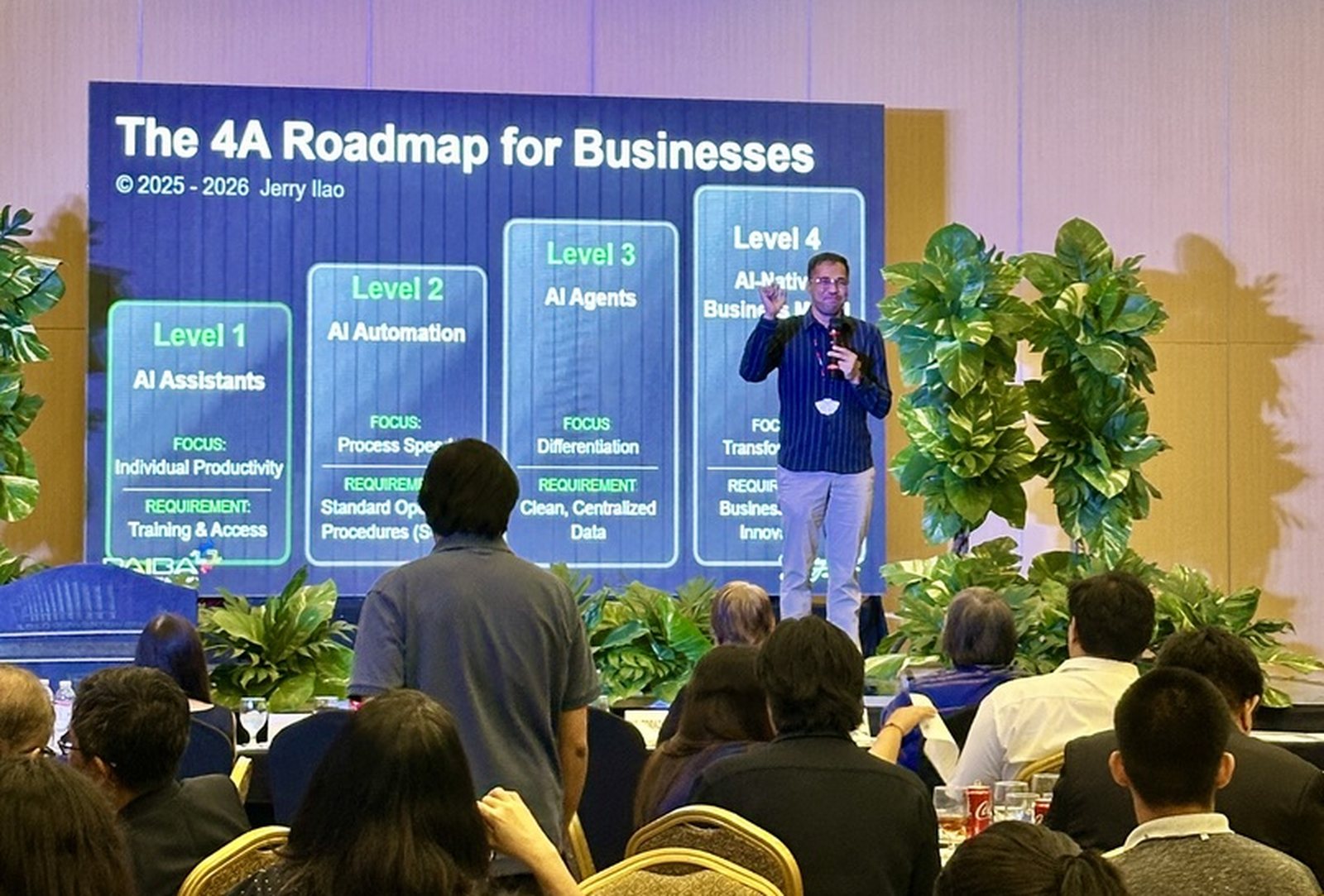
Jerry Ilao on stage teaching The 4A AI Roadmap to a room of Filipino business owners, with the four-level slide behind him
The 4A AI Roadmap taught live. Its levels and gates were refined in rooms like this, across hundreds of workshop conversations with Filipino business owners.
Reference

Citing this framework

To reference the 4A AI Roadmap in articles, research, presentations, or training materials: Ilao, J. (2026). The 4A AI Roadmap™: A four-level AI maturity framework for Philippine businesses (v1.2). Retrieved from https://jerryilao.com/4a-ai-roadmap Journalists and researchers: for interviews, data, or the current one-pager, contact jerry@olern.com.

Version history: v1.0 (Oct 2025) — the original four-level model · v1.1 (May 2026) — capability-based Level 2, gate scoring · v1.2 (Jul 2026) — the 4A naming and the Three Mindset Shifts, toolkit integration, data grounding; renamed to The 4A AI Roadmap, canonical URL moved from /4a-roadmap (which redirects here). The framework is versioned and evolves; this page always reflects the current release.